Do you want bass that gives you goosebumps…
Ole Witthøft
Welcome to the second episode in our series about subwoofers. In the first episode, you learned how sound has changed from almost no bass in the 70s and 80s to deeper bass in the 90s and onwards. The new sound makes music bigger and more gripping and requires a music system with updated performance. This episode is about something crucial for your sound experiences. We call it speed.
Why does speed matter? Because it determines whether you experience music – or just hear a bunch of tones muddled together.
Speed is about how quickly the subwoofer can start and stop. It’s measured in milliseconds, but you experience it as rhythm, precision, and control.
When the subwoofer is fast, you can follow the rhythm, and each bass tone sounds like a note – not just one big BOOOM.
If the subwoofer is slow, the sound is imprecise and it stays in the room. Our ears can detect delays over 30–50 milliseconds, and large delays ruin the experience. Therefore, a subwoofer must be faster than that, so the bass blends with the rest of the music.
Most buyers only look at the specifications when choosing a subwoofer. They dream of the subwoofer with the deepest bass but never visit a store to hear the difference with their own ears. The speed of the subwoofer isn’t specified in technical specifications, and disaster is just around the corner (!).
The subwoofer that plays the deepest is typically a bass reflex model – and it’s slow (+30 milliseconds). The result is a sound that never really comes together, and we hear it clearly. Add to that, sound travels 3 milliseconds per meter. If the subwoofer is placed a bit too far away, it gets even worse.
Everything ends up in BOOOM, BOOOM – instead of precise, musical bass.
Speed requires a completely different approach to subwoofers. Our models are built according to the sealed enclosure principle, which is much faster than bass reflex. They stop in just 10 milliseconds – so fast that your ears experience the sound as extremely precise.
But sealed enclosures have one challenge: They’re not as good at the lowest frequencies. That is why we use another tool.
A subwoofer should play with the room – not against it. That is why System Audio’s subwoofers are designed to be placed close to a wall or in a corner.
Surfaces amplify the sound and a wall gives an effect equivalent to doubling the size of the subwoofer. A corner amplifies even more – like a natural horn. We have factored this effect into the design, so our subwoofers can be smaller, but still sound big.
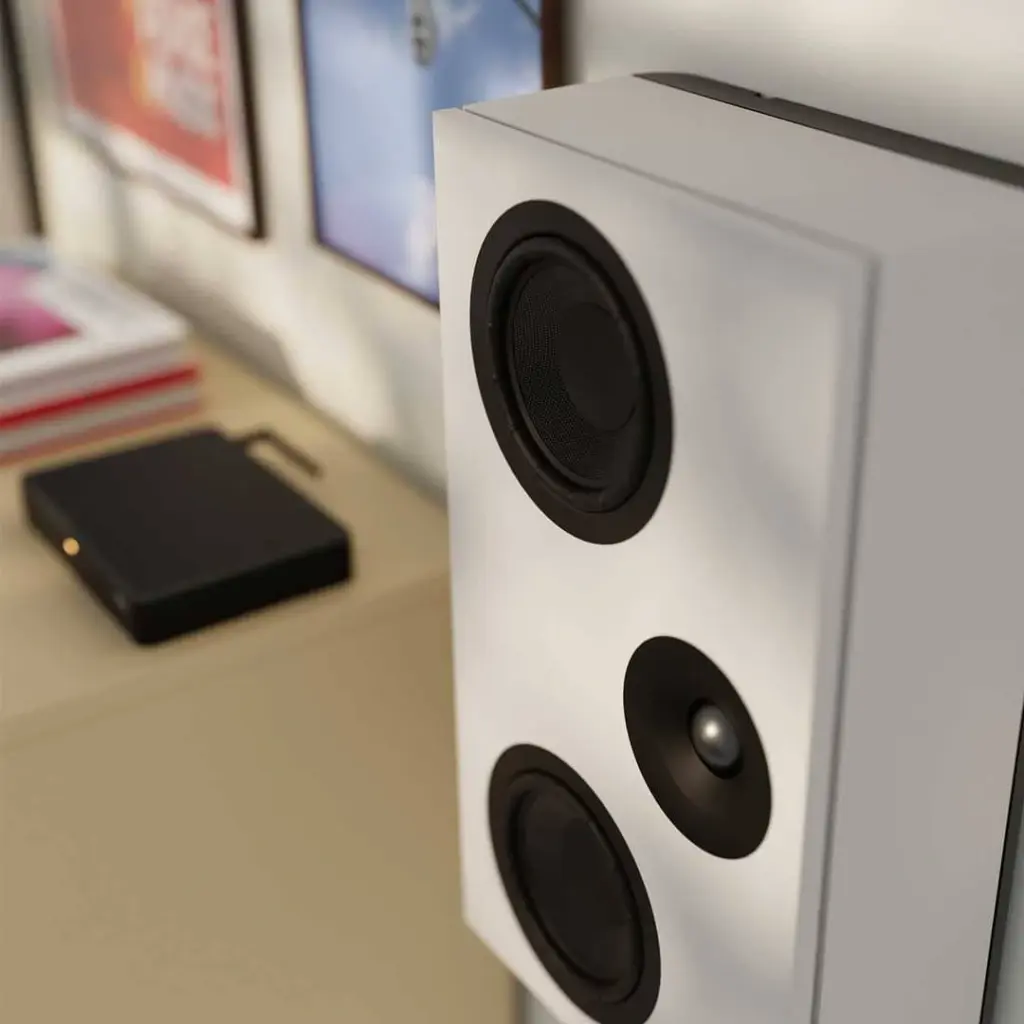
Silverback Sub Solo and Sub Duo have built-in wall mounts, so they’re easy to hang on the wall without causing vibrations. Signature Sub 8 is designed for both corner placement and close to a wall and works perfectly in music systems or home theaters.
Sound travels about 3 milliseconds per meter. This means that even small distances affect precision. That’s why SA Cockpit – our app – can fine-tune the system down to the smallest detail. Here you can set the distance for each speaker, so the sound from all units reaches you at exactly the same time. This is crucial for a perfect sound experience.
Signature Sub 8 also supports this feature when used with Stereo Hub HT and Surround Hub.
This is the second episode in our series about subwoofers. You’ve learned why speed is crucial for a good subwoofer: A slow subwoofer makes the sound stay in the room, while a fast subwoofer delivers precision, rhythm, and musical bass that blends with the rest of the sound.
We’ve talked about how System Audio combines sealed enclosure technology with the power of acoustics and intelligent control to create subwoofers with both speed and depth.
The next episode is about something that affects us all: We play at low volume 95% of the time, and that means our ears hardly hear bass. We have technology that makes bass audible at low volume. More about that next time!